
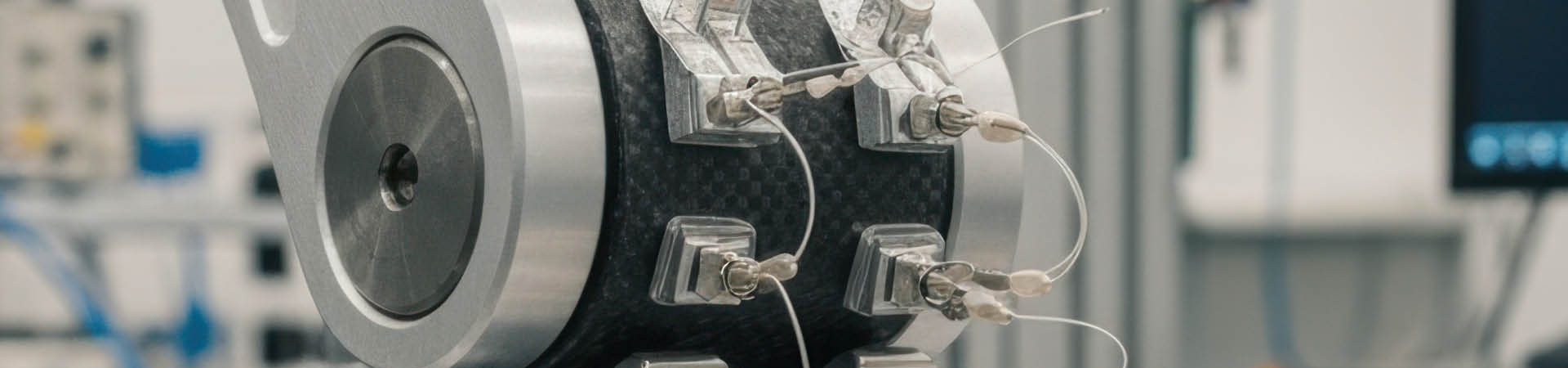
Instrumentation and Business Engineering
Electronic/Electrical Test and Measurement | Optical Measurement | Physicochemical Analysis | Measurement Chain | Trade (B to B)
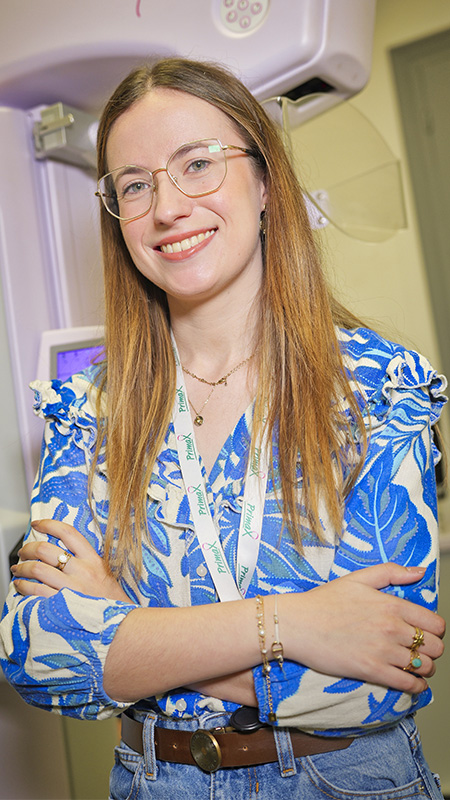
Engineers trained by the department of Measurement Systems and Applied Business are specialists in measurement and analytical instruments in the areas of electronics, physics and chemistry. They benefit from a dual competence that is both technical and commercial, not only enabling them to detect, understand and analyse an instrumental need but also to market and/or develop appropriate solutions.
They are able to offer companies a global solution, combining both commercial and scientific aspects, by analysing the client’s requirements in order to propose a multi-dimensional solution (through technical expertise, negotiation with the client, training programs and personally accompanying the client).
Given their multidisciplinary training, they are reactive and can constantly adapt to technological evolutions. Thanks to their varied competences, they can look forward to extremely favourable employment prospects.
During the program, the student engineer will simultaneously follow:
> A broad scientific program of study (analog and digital electronics, telecommunication circuits and components, optics, lasers, chemistry…) enabling future engineers to rapidly adapt to new technologies and products.
> A program in economics and commerce, which goes beyond what is generally offered in traditional engineering schools, enabling the student engineer to acquire notions which are specific to a business program: economic and social environment, sales techniques, management control, finance, taxation, commercial law, international commerce, marketing, project management. The opportunity to acquire and practise communication techniques and to study two foreign languages (with a specialization in business English) completes the program, allowing the engineer to evolve and progress in international contexts.
Classes are taught in French.
Activity sectors
- Electronic instrumentation
- Spectroscopic and physico-chemical instrumentation
- Telecommunications, networks and IT
- Business and engineering services
- Transport, research, health, energy, …








Links with research units
Associated research unit :
- IEMN - Electronics, microelectronics and nanotechnology
- LASIRe - Spectroscopy for interactions, reactivity and environment
- UCCS - Catalysis and solid-state chemistry
Program
UE 5.1 Mathematics, Information Technology (IT)
- Goals to be achieved :
Give the students the mathematical prerequisites for electronic, signal processing and image processing modules. - Course details :
Chapter 1: Fourier series
Chapter 2: Fourier transform
Chapter 3: Laplace transform
Chapter 4: Solving differential equations
Chapter 5: Functions of several variables
Chapter 6: Multiple integral calculus
24 h Tutorial
3 h DS
- Goals to be achieved :
Make a simple computer program, from design to development, with a suitable programming language. Be able to understand the existing software applications and to identify the needs and constraints to make them evolve. - Course details :
- Introduction to computer architecture, operating systems and networks
- Basic programming and algorithm: data types, control, subprograms, data structures, Python programming language
- Reading list :
Bibliographie générale sur l'ordinateur, l'algorithmique de base , les bases de données et les documents liés au langage de programmation employé.
26 h Practical
1 h DS
UE 5.2 Electronics and Systems
UE 5.3 Physics and Chemistry
UE 5.4 Business and Human Sciences
Unit Languages
UE 6.1 Optics & Quantitative Sciences
- Goals to be achieved :
Interference and diffraction of light with a focus on instrumentation and applications.
Handle applications such as optical filters,surface analysis, refractive index characterization, default detection.
Master basic scientific concepts of optical physics
Master basic scientific concepts of optical instrumentation - Course details :
1. Geometrical optics, light, wave propagation and Maxwell equations, energy
2. Interference patterns and applications of interferometry measurement for optical characterization
3. Fundamental of Fraunhoffer diffraction, measurement and characterization of appertures - Reading list :
18 h Tutorial
20 h Practical
1 h DS
- Prerequisites :
411320
- Goals to be achieved :
UV-VIsible absorption spectroscopy of atoms and molecules - Reading list :
12 h Tutorial
16 h Practical
1 h DS
- Goals to be achieved :
Optimise chromatographic separations through theoretical calculations.
Propose instrumental solutions to troubleshoot specific analytical problems in chromatography.
Know the structure and the operating principles of chromatography devices. - Course details :
1) Theoretical principles of chromatography: stationary and mobile phases, elution, analytical and preparative chromatography, distribution coefficient, retention time, solute displacement velocity, retention factor, separation factor, height equivalent to a theoretical plate, resolution, longitudinal diffusion, mass transfer, van Deemter equation;
2) Gas chromatography instrumentation: carrier gases, flow regulators, columns, ovens, detectors;
3) Liquid chromatography instrumentation: carrier solvents, flow regulators, columns, detectors. - Reading list :
6 h Tutorial
4 h Practical
1 h DS
UE 6.2 Analog and Digital Electronics
UE 6.3 Sensor and measure
UE 6.4 Marketing and Business Issues
UE 6.5 Unit Languages
UE 7.1 Scientific project and Molecular spectroscopy
1 h DS
- Reading list :
Existence d'un document complet de Cours
16 h Practical
1 h DS
- Prerequisites :
411110|411320|412110|412130|412240|921210|922110
- Goals to be achieved :
Essentials of light-matter interaction and molecular spectroscopy:
in the optical domain of the electromagnetic spectrum (rotational spectroscopy, vibrational spectroscopy - basics of absorption, emission and Raman analysis). understanding the main analytical concepts and applications, such as gaz analysis or microimaging of biomedical samples. Scientific and intrumental concepts of the measurements. Main spectroscopic tools and methods such as laser sources, microscopes, interferometry or Fourier Transform) - Course details :
Teaching is organized in 4 sections, with independant exercises and analysis of industrial applications notes from spectrometers suppliers.
1. Fundamentals of light matter interations
2. Rotational spectroscopy
3. Vibrational spectroscopy.
4. instrumentation and investigation and analytical cases. - Reading list :
- Reading list :
* D.A. SKOOG and J.J. LEARY, « Principles of Instrumental Analysis » 4th Edition, Saunders College Publishing, 1992
* Accès Internet : nombreux sites d'auto-formation
8 h Tutorial
1 h DS
- Goals to be achieved :
Know the operating principles of the best-established approaches of multivariate data analysis.
Propose and develop statistical analysis protocols for the exploration, processing and interpretation of multivariate data.
Adapt multivariate data analysis protocols to the specific nature of the analytical and instrumental problems at hand. - Course details :
1) Basics of linear algebra: definition of vectors and matrices, vector/matrix addition, vector/matrix multiplication, vector/matrix transposition, matrix inversion and pseudo-inversion;
2) Geometry of multivariate data;
3) Principal component analysis;
4) Multivariate regression: multiple linear regression, principal component regression, partial least squares regression;
5) Multivariate curve resolution.
10 h Tutorial
- Prerequisites :
411120|413450|411320
10 h Project
UE 7.2 Electronics, Instrumentation and Measurement
UE 7.3 Business Engineering
Unit 7.4 Languages
UE 8.1 Lasers, Photonics
- Prerequisites :
412240|412250|413360|413410|413430|413580|413600|921120|921150|921210|922110
- Goals to be achieved :
Master the concepts and theory of physical optics and Fraunhoffer diffraction.
Apprehend the basic applications of lLasers and Fourier optics, such as image analysis. signal filtering, spectroscopy instrumentation.
Being able to conceptualize basic instrumental set ups and the related methodology for data acquisition, data analysis and image processing - Course details :
1. Optical instrumentation, instrumental set-up basics
2. Fourier optics and applications
3. Basic applications of non linear optics in optical spectroscopy
4. Fourier optics, holography, imaging, image processing, biomedecine applications - Reading list :
- Prerequisites :
411210|411230|412130|413410
- Goals to be achieved :
This practical work aims at designing, building and testing a colorimeter based on Light Emitted Diode. Student will have to:
* handle the scientific and technical concepts of measurement systems
* use their knowledge in electronics, signal processing, instrumental analysis... - Course details :
The different steps are the :
1) Choice of the components (LED and photo-diode)
2) Design of the electronics (signal conditioning ?.)
3) Data acquisition and processing under Labview to display the absorbance
4) Test of the prototype with filter and standard solution
5) Evaluation of the characteristics of the systems (detection limit, linearity domain, reproducibility...) - Reading list :
Supports de cours fournis
UE 8.2 Measurement, RF
UE 8.3 Project and applied Marketing
UE 8.4 Internship
UE 8.5 Languages
UE 9.1 Specialty Modules
- Reading list :
- Prerequisites :
Electronic knowledge on the:
matching impedance, power transfer Matrices quadrupole and dipole (impedance, admittance, transfer, hybrid).
- Goals to be achieved :
At first, the basic concepts are presented microwave to understand? Origin of specific devices to high frequency domain. Namely, the scalar and vector analyzers networks, frequency synthesizers, power meters and finally the spectrum analyzers. In a second step, the synoptic of these tools are described, an analysis of the advantages and disadvantages of these devices are presented and methods of use to ensure clarification of the largest possible measures. - Course details :
Microwave presentations notions (Scattering parameters, coefficients of reflection and transmission, TOS, VSWR, impedance matching, standing wave ...).
Presentation and use of the Smith chart;
Presentation of different network analyzers (Scalar and vectorial) and methods associated for the calibration;
Synoptic presentation and correlation between sheets and elements constituting these devices;
Presentation of different power meters (diode calorimeter bolometer). - Reading list :
20 h Project
- Prerequisites :
411320|412130