
Biological and food engineering

Food and biological production | Biotechnologies | Sustainable food | Quality, hygiene, safety, environment | Bio-resources and bio-products
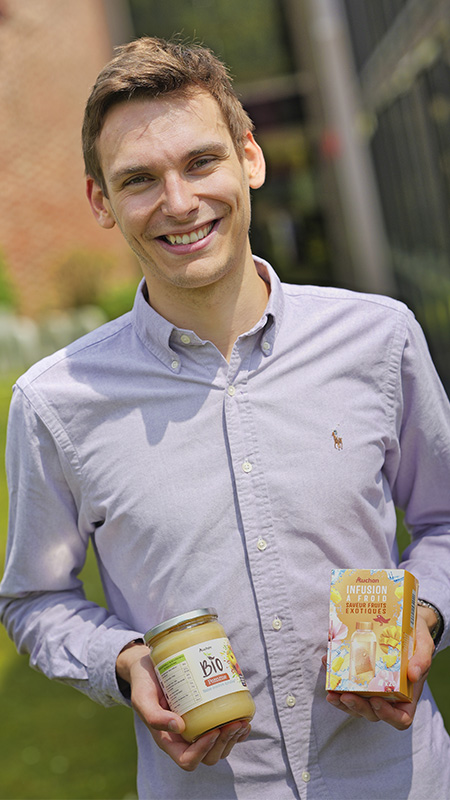
Gatien, ingénieur Produits Epicerie Sucrée - Auchan Retail

The program in Biological and Food Engineering trains multiskilled engineers who work in different sectors of activity: food processing, biotechnology, the environment, cosmetics, personal hygiene products and retail. Using a combination of scientific and technical knowledge, as well as managerial competences, engineers from this program can call upon human, material and financial resources in order to meet the complex and exciting challenges specific to businesses in these different sectors.

The program is designed around the following areas:

– products classified according to their chemical composition and on various properties – physico-chemical, health, nutritional, sensory…
– processes and bio-processes used to obtain these products or to recover and enhance agri-resources and waste
– the tools necessary to control and optimize these processes, as well as the quality of the products,
– essential areas of the Humanities and management which participate in the development strategy of a given company
– practical work experience (placements, projects) which allow the student engineer to assimilate the knowledge imparted and develop, in a team environment, his/her capacities in defining, organizing and realizing tasks.
The personalized path offered in the final year allows the student engineer to adapt the training offered to his/her career plan.
Constant links with industry exist and manifest themselves through work placements, projects, visits to different companies, as well as the participation of industrialists in the program.

Classes are taught in French

Activity sectors

  • Food processing
  • Design offices
  • Chemical / healthcare industry
  • Retail
  • Research and Development
  • Production / Exploitation
  • Quality / Security / Environment
  • Sales / Brand Director

Program

Unit 5.0 Upgrading courses

26h
ECTS
Hours
711001
Unit 5.0 Upgrading courses
0
26 h
711010
Upgrading course
18 h
  • Goals to be achieved :
    The aim is to provide tailored support to students at the start of their degree programmes: in mathematics for students with a background in biology, and in biology for students with a background in physics, mathematics or chemistry.
  • Course details :
    The fundamentals of mathematics on the one hand, and microbiology and biochemistry on the other.
711011
Biology
 
  • Goals to be achieved :
    Basic knowledge in biochemistry and microbiology
  • Course details :
    Structural biochemistry of carbohydrates, lipids and proteins
    Introduction to general microbiology
  • Reading list :
    Biochimie générale, WEIL JH
    Microbiologie, Prescott et al.
    Atlas de biologie Vogel G et Angermann H
8 h Practical
711012
Mathematics for Engineers
 
  • Goals to be achieved :
    To provide an introduction to some of the basic mathematical tools used in other disciplines within the agri-food engineering curriculum
  • Course details :
    - Further study of analytical concepts used in modelling physical phenomena: rates of change/velocity, derivatives, differentials, limit expansions of a function in the vicinity of a point, applications to the local analysis of a function’s behaviour and the approximation of its values, calculation of limits.

    - Fundamentals of matrix calculus, the concept of the inverse matrix, solving systems of linear equations with invertible matrices. Gauss’s pivot method
18 h Tutorial
1 h DS
711020
Hygiene and Safety
2 h
  • Goals to be achieved :
    Good laboratory practices and health & safety rules, particularly in biochemistry and microbiology laboratories.
  • Course details :
    - Good laboratory practices (mandatory clothing, PPE, CPE, etc.)
    - Main chemical, biological, and fire hazards
    - Rules for handling chemicals and microbiology in the laboratory
    - Rules for sorting and disposing of waste
    - Alert and evacuation procedures
  • Reading list :
    Livret d'accueil prévention et sécurité pour les nouveaux entrants de la plateforme Génie Biologique et Alimentaire de Polytech Lille
2 h Tutorial
711030
Using a digital learning environment
2 h
  • Goals to be achieved :
    Effectively use digital communication, coordination and collaboration tools
    Effectively use Lille university's Moodle learning platform to follow GBA training
  • Course details :
    Access Moodle ULille and log in
    Use the Moodle ULille home page
    Use your personal dashboard on Moodle ULille
    Set your preferences on Moodle ULille
    Use personal messaging on Moodle ULille
    Register for a Moodle course
    Participate in Moodle course activities
    Use the Moodle calendar

    Start or continue using the PIX platform to assess, develop and certify your digital skills
2 h Practical
711040
Introduction to bibliographic analysis project
4 h
  • Goals to be achieved :
    This project provides both an introduction to project management and an introduction to literature reviews, which are generally the first step in any project and involve gathering the information needed to carry it out.
  • Course details :
    The project undertaken by engineering students during their first year involves producing a literature review on a topic relating to the study of a production process.
    The basis of the literature review will consist of the analysis and synthesis of three scientific articles, i.e. articles presenting research findings and published in international scientific journals.
    Four hours of training in literature research and project management are provided at the start of the project.
  • Reading list :
2 h Tutorial
2 h Practical

Unit 5.1 Introduction to biological engineering

126h

UE 5.2 GBA Engineer Tools 1

122h

Unit 5-3 Sustainable development and food 1

62h

UE 5-4 Unit Languages

48h

UE 6.1 Transformation of bioresources

108h
ECTS
Hours
712100
UE 6.1 Transformation of bioresources
7
108 h
712101
Process engineering
5
 
  • Goals to be achieved :
    See sheets of the 3 parts of this course :
    - Heat and matter transfers
    - Unit operations
    - Process Engineering Projec
  • Reading list :

712102
Heat and mass transfer
1.25
16 h
  • Prerequisites :
    711012|711040
  • Goals to be achieved :
    Acquire the basic concepts of heat and matter transfer phenomena.
  • Course details :
    * Heat transfer: study of the different modes of steady-state heat transfer: conduction (Fourier's law) , convection (Newton's law), correlations for estimating the heat transfer coefficient by convection, combined conduction & convection heat transfer. Estimation of the overall heat transfer coefficient.

    * Matter transfer: modes of matter transfer (diffusion, convection); Fick's laws; generalized equation and examples of analytical solutions; matter transfer coefficient and correlations for its determination; matter transfer models (film model, double film model); cases specific to biological and food engineering: agitated aerated tank and food packaging; concept of non-stationary transfer.

  • Reading list :
    Bimbenet , Duquenoy et Trystam (2021), Génie des procédés alimentaires. Des bases aux applications, Dunod, Paris.
    Bazinet et Castaigne (2011), Concepts de génie alimentaire, Lavoisier Tec&doc.
8 h Lecture
8 h Tutorial
1 h DS
712104
Process engineering project
2
14 h
  • Prerequisites :
    711030|711201|712102|712103|712105|712501
  • Goals to be achieved :
    Be able to produce a manufacturing diagram and size a few unit operations. Be able to analyse the issues involved in the ecological transition (materials, energy). Be able to work in a group. Be able to find relevant information and use it.
  • Course details :
    The Process Engineering project is divided into 4 stages, each giving rise to a deliverable written in group. Stage 1: Drawing up a production diagram for a product resulting from the processing of a raw material of plant origin, and identifying the sources of heat that can be recovered. Stage 2: Study the unit operations of extraction, LS and filtration. Stage 3: Study of concentration by evaporation Stage 4: Study of drying and analysis of material losses throughout the process.
  • Reading list :


14 h Project
712105
Valorization of biomass
2
40 h
  • Prerequisites :
    711101
  • Goals to be achieved :
    Understanding the links between characteristics of raw materials, storage, conversion processes and end-products.
    Ability to design technical solutions
    Ability to study and solve problems
    Ability to take into account the challenges of sustainable development and meet societal values, SDG : 2, 6, 12, 13
  • Course details :
    1 Non-food recovery
    1.1 Biofuel
    1.2 Bioplastics
    2 Food recovery
    2.1 Storage of harvests
    2.2 Processing of industrial crops
    2.3 Dairy, meat and seafood products
  • Reading list :


40 h Lecture
1 h DS

UE 6.2 Bioengineering

66h

Unit 6-3 Sustainable development and food 2

44h

Unit 6-4 GBA Engineer Tools 2

79h

Unit 6-5 Human Economic Legal and Social Sciences 1

46h

UE 6-6 Unit Languages

48h

Internship

UE 7.1 Process Engineering

61h
ECTS
Hours
713100
UE 7.1 Process Engineering
5
61 h
713101
Food preservation techniques
2
23 h
  • Prerequisites :
    711102|711201
  • Goals to be achieved :
    Evaluate and know food microbial contamination
    Know methods used to calculate processing times and temperatures in heat preservation process of foods, with application to pasteurization and canning.
    Select alternative techniques of food preservation
    Propose optimization of heat preservation of foods
    Know machines and standards

    SDG : 2,7,12,13
  • Course details :
    Microbial growth
    Pathogen microorganisms
    Physiology of thermoresistance
    Kinetic of destruction of micro-organisms versus time and temperature
    Secondary reactions and optimization
    Calculus of thermal processing in retorts: Bigelow General method and Ball-Stumbo Formula method
    Machinery and standards

  • Reading list :
    ODD 2 & 3

    TEIXEIRA, Arthur. Thermal processing of canned foods. In : Handbook of food engineering. CRC Press, 2006. p. 757-810.
5 h Lecture
6 h Tutorial
12 h Practical
1 h DS
713102
Drying technology
3
38 h
  • Prerequisites :
    711101|712101|712102|712103|712104|712202|713202|713101
  • Goals to be achieved :
    Drying or dehydratation is the single common unit operation in the industrie and more especially an operation of great importance to the food industry. The course provides a comprehensive study of food processing engineering, beginning with the basic definitions and principles , followed with drying kinetics and mass and heat transfer balances and continuing all the way to drying equipement and practical application.
  • Course details :
    General Introduction of the drying: Principle and definition, Types of drying, Humid air parameters, Diagrams of drying, Modes of drying
    Drying kinetics
    Dryiers, Drying calculation
    Specific cases of drying
    Security of the drying process
    Environmental protection
  • Reading list :


    J. J. Bimbenet, A. Duquenoy, G. Trystram (2002), Génie des procédés alimentaires. Des bases aux applications., Dunod, Paris ; M. Loncin (1976) Génie industriel alimentaire, Masson ; R. T. Toledo (1994), Fundamentals of food process engineering, Second edition, Chapman and Hall ; R.B. Keey (1972) Drying Principles and Practice, Pergamon Press ; P. Mafart (1992) Génie Industriel Alimentaire. Vol. 1 and 2. Tec & Doc Lavoisier, Paris
6 h Lecture
12 h Tutorial
20 h Practical
1 h DS

Unit 7-2 Bio- and food engineering

100h

Unit 7-3 GBA Engineer Tools 3

77h

Unit 7-4 Human Economic Legal and Social Sciences 2

58h

UE 7-5 Innovation project 1

32h

UE 7-6 Unit Languages

48h

UE 8-1 Industrial engineering

58h
ECTS
Hours
714100
UE 8-1 Industrial engineering
4
58 h
714101
Material and Production planning
3
43 h
  • Prerequisites :
    711202|711012
  • Goals to be achieved :
    Develop skills and knowledge in production control in food industries.
    Manage material planning
    Manage resource planning
    Handle such specific aspects to food production management (combined Make To Order / Make To Stock strategies, perishable goods inventory control, seasonality, multiple recipes, batch orders.)

    SDG : 12
  • Course details :
    Lectures (8 hours)

    0- Introduction: food industry constraints and goals case studies
    1- Basics of computer-aided production management
    2- Material Requirement & Manufacturing Resource Planning
    3- Inventory control
    4- Kanban & Just-in-Time methods
    5- New tools: Introduction to ERP. Solving case studies

    Slides are in english.

    Practical work ( 8 hours)

    An example of a cooked meats processing plant is considered to illustrate the MRP method. The educational software Prelude is used to perform material requirement planning and schedule resources. The students have to answer a number of questions regarding various aspects of production control.

    Outline :
    1- Getting started; Database management
    2- Manufacturing and sales plan,
    3- Net requirements planning, infinite capacity loading
    4- Scheduling, inventory control, sourcing strategies
  • Reading list :
    ODD12
    Gestion de production / A. Courtois, C. Martin, M. Pillet ., Editions d'organisation, 2011, 5e edition
    G. Javel Organisation et gestion de la production : cours avec exercices corrigés /
    4e édition, Dunod, 2010
    Treillon, R., Lecomte, C. Gestion industrielle des entreprises alimentaires : techniques et pratiques de la gestion des flux , Tec. Et Doc. Lavoisier
12 h Lecture
8 h Practical
1 h DS
714102
Risk and Safety Management
1
15 h
  • Goals to be achieved :
    Identify the challenges of setting up an integrated QSE management system
  • Course details :
    - Organization and Maintenance Management
    - Safety of production systems (Using standardized reference)
    - The role of the engineer in crisis management
    - Controlling risks and impacts of environmental
  • Reading list :
    Code du travail - Légifrance - AFNOR - INRS - CRAM
11 h Lecture
4 h Tutorial

Unit 8-2 Industrial biotechnologies

68h

UE 8-3 Innovation project 2

24h

Unit 8-4 Human Economic Legal and Social Sciences 3

72h

UE 8-5 Languages

48h

UE 8-6 Unit Internship

120h

Unit 9-1 Quality Management and Environment

47h
ECTS
Hours
715100
Unit 9-1 Quality Management and Environment
3
47 h
715101
Water technology
1.5
24 h
  • Prerequisites :
    711101|711201|712101|712103|713203|714201|714202
  • Goals to be achieved :
    Knowledge on waste-water treatment, especially related to food industry effluents
  • Course details :
    Industrial water pollution (characteristics, classification, measurements). Regulation
    Waste-water treatment processes: 1/ Preliminary treatments (screening and grid removals, deoiling, neutralization, homogenization, etc.); 2/ Physico-chemical treatments (coagulation-flocculation, setting, flotation, adsorption, ion exchange, membrane filtration, etc.); 3/ Chemical treatments (oxidation-reduction, chlorination, ozonation, metal ions precipitation, etc.); 4/ Biological treatments: Principal microorganisms and microbiological processes involved in the treatment of organic pollution (carbon, azot, phosphate); Principal bio-treatments (aerobic and anaerobic processes with fixed or suspended biomass, activated sludge); Conception and dimensioning of activated sludge installations.
    Treatment of the sewage sludges.
    Water-treatment plant. Guided visit of the installations.
  • Reading list :
    Technique de l'ingénieur

8 h Lecture
16 h Tutorial
1 h DS
715102
Quality Management, Environment
1.5
23 h
  • Prerequisites :
    921125|922410|714102|714101|713401|711020|711301
  • Reading list :


    Code du travail - Légifrance - AFNOR - INRS - CRAM
19 h Lecture
4 h Tutorial

Unit 9-2 Industrial Food Engineering

44h

UE 9-3 Circular economy

81h

Unit 9-4 Human Economic Legal and Social Sciences 4

55h

UE 9-5 Unit Languages

40h

UE 9-7 Cross-disciplinary modules

24h

UE 9-8 Engineering Project

100h

UE 10-1 Unit Engineer placement

400h
ECTS
Hours
926100
UE 10-1 Unit Engineer placement
30
400 h
926110
Engineer Placement
30
400 h
400 h Project

UE 10-1ALT Formative assessment

51h

UE 10-2ALT Enterprising Challenge

35h